Coway Airmega Mighty AP-1512HH review
exact_model_purchase_decision
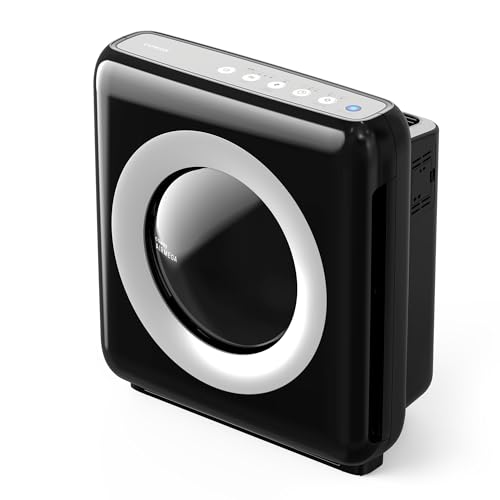
Bottom line
The Coway Airmega Mighty AP-1512HH has a clear core proposition: strong published particle CADR for its size, simple controls, Auto and Eco behavior, and established filter-maintenance guidance.
Coway Airmega Mighty AP-1512HH review: capable particle airflow, but mind the room-size math and ionizer
As an Amazon Associate I earn from qualifying purchases.
No affiliate destination or tracking tag is authorized in this draft.
Direct answer
The Coway Airmega Mighty AP-1512HH remains a plausible choice for someone who wants a compact, non-connected purifier with substantial published smoke CADR, automatic fan control, an Eco mode, and widely documented replacement filters.[1][2][4]
The strongest case is a bedroom or similarly enclosed room sized around Coway’s 361-ft² presentation at 4.8 air changes per hour, assuming an 8-ft ceiling.[1][2]
The much larger 874-ft² and 1,748-ft² figures are the same airflow presented at only 2 ACH and 1 ACH, not equal-performance room ratings.[1][2]
Skip or compare more carefully if you want app controls, a calibrated PM2.5 display, a mechanical-only design with no ionizer, or evidence tied to a known current hardware revision.[2][6][8]
The optional ionizer can be switched, but a dated ENERGY STAR record reports 9.0 ppb ozone for AP-1512HH*, so this article does not call the purifier ozone-free or universally safe.[2][3]
Exact product covered
This review covers only the 120 V, 60 Hz Coway Airmega Mighty family named in the current United States/Canada/Mexico manual as AP-1512HH, AP-1512HH(B), and AP-1512HH(W).[2]
Coway currently presents white and black choices, and the manual maps the (B) and (W) suffixes to black and white naming.[1][2]
The white neutral identity candidate is ASIN B01728NLRG for AP-1512HH(W), while the black candidate is ASIN B00BTKAPUU for AP-1512HH and corresponds to the manual’s black suffix naming.[2][15][16]
No reviewed source defines a hardware-revision boundary across the product’s long sales history, so the hardware revision remains unknown.[1][2][3]
Explicit exclusions
This review excludes AP-1512HHS and AP-1519P Airmega MightyS because Coway identifies that as a connected model with different filters and controls.[6]
It excludes AP-1512HHC, including AP-1512HHC(BG) and AP-1512HHC(WT), because Coway publishes different CADR, power, noise, and package claims for the beige model.[7]
It excludes Airmega 200M and AP-1518R; sharing replacement-filter fit does not make those purifiers equivalent.[4]
It excludes Airmega 150, 160, 250, 300, and 400, unmatched regional variants, custom filter packages, replacement filters as products, retailer bundles, renewed or open-box units, third-party compatible filters, and every other unproven equivalent.[2][4]
How this review was built
One Big Review did not buy, own, measure, or hands-on test this purifier.
This draft uses the current Coway product page and manual plus current filter information.[1][2][4]
It also uses dated ENERGY STAR and CARB records captured for the brief.[3][10]
Retailer identity pages and one revision-incomplete HouseFresh test are used as identity evidence and attributed context, respectively.[13][15][16]
The ENERGY STAR detail page and CARB device rows are dynamic and were not fully exposed in the fresh extractor, so their exact fields are kept tied to the named record IDs, orders, dates, and canonical source capture rather than generalized.[3][10]
The Coway warranty webpage failed extraction in this run, so warranty wording below is anchored to the accessible current manual and remains subject to current controlling terms.[2][5]
Recall status is unresolved because the CPSC query URLs did not yield a reproducible model-filtered result in this run.[11][12]
CADR and room sizing
Coway’s current page lists clean-air delivery rates of 233 cfm for smoke, 246 cfm for dust, and 240 cfm for pollen.[1]
The current manual prints smoke CADR 233 but does not repeat the complete three-number set in its specification table.[2]
ENERGY STAR unique ID 2359491, certified on January 14, 2013 for model family AP-1512HH*, records 233.6 cfm smoke, 247.7 cfm dust, and 232.2 cfm pollen.[3]
Those dated values do not exactly match the current Coway page, so this review preserves both datasets rather than rounding them into one claim.[1][3]
Coway publishes 361 ft² at 4.8 ACH, 874 ft² at 2 ACH, and 1,748 ft² at 1 ACH, all using an 8-ft ceiling basis.[1][2]
At 4.8 ACH, the stated turnover is once every 12.5 minutes; at 2 ACH, once every 30 minutes; and at 1 ACH, once every 60 minutes.[2]
ENERGY STAR’s dated record uses 362 ft² rather than Coway’s current 361-ft² figure.[3]
For a buyer comparing purifiers, CADR plus the desired air-change rate is more informative than repeating “covers 1,748 ft²” without its 1-ACH limitation.
No room-size number here establishes medical benefit, smoke-event suitability, infection control, or equal performance at every ceiling height.[2][3]
Mechanical filtration, carbon, sensor, and optional ionizer
The manual identifies three physical stages: a reusable pre-filter, a deodorization filter, and a HEPA filter.[2]
Coway’s current product page markets a four-stage system by adding a bipolar device to those physical filters.[1]
The ionizer has a separate on/off control and should be understood as an optional electronic function, not as another mechanical filter.[2][8]
The pre-filter handles larger debris before air reaches the deodorization and HEPA media, while Coway positions the deodorization filter for odor control.[2][4]
This review does not turn manufacturer filter-media or small-chamber results into whole-room clinical outcomes, and Coway’s own disclaimers say actual living-environment performance may vary.[9]
The dust sensor drives the indicator and automatic fan response, with blue, dark-purple, and red status colors and sensitivity choices described as sensitive, standard, and insensitive.[2]
No reviewed source establishes that the sensor is a calibrated PM2.5 monitor or specifies its particle-size accuracy.[2]
Controls, Eco mode, timer, noise, and power
Manual speed control has three levels, while Auto and Eco are operating modes; Coway’s “five stages” wording should not be read as five manual fan speeds.[1][2]
In Auto mode, the unit selects speeds 1 through 3 in response to the dust sensor.[2]
In Eco mode, the fan stops after 30 minutes when the sensor detects no pollution, then can resume when pollution is detected.[2]
The timer choices are 1, 4, and 8 hours.[1][2]
Coway’s current page lists 24–53 dB(A), while the one-sheet uses 22 dB(A) in feature prose and 24.4–55.1 dB(A) in its specification area.[1][14]
HouseFresh reports 38.9, 44.4, and 60.1 dBA for speeds 1, 2, and 3 measured from 3 ft away on its single unit.[13]
Those manufacturer and independent figures do not share a fully comparable protocol, so none should be used to erase the others.[1][13][14]
Coway’s current product page and manual specify 77 W, while ENERGY STAR’s dated record lists 462.3464865 kWh/year and 0.5 W partial-on power under its own record basis.[1][2][3]
This review does not estimate annual electricity cost because price, duty cycle, fan use, and Eco behavior vary.
Size, weight, and what comes in the box
Coway gives dimensions of 16.8 inches wide by 18.3 inches high by 9.6 inches deep, with manual metric dimensions of 43 by 46 by 24 cm.[1][2]
Coway and the manual give a nominal weight of 12.3 lb or 5.5 kg.[1][2]
The canonical retailer records list 12.5 lb for white and 12.3 lb for black, but that difference is not evidence of a hardware revision.[15][16]
The manual says to remove the filter bags before use and shows the filter installation order.[2]
A black retailer record names a filter set and manual, but that does not prove identical box contents for every white unit, seller, or production period.[15][16]
Verify the exact color, suffix, seller, condition, and included filter package before any purchase.
Filter care and replacement guidance
The pre-filter may be vacuumed or washed, and it must be completely dry before reinstallation.[2]
The deodorization and HEPA filters are not washable and are not described as reusable.[2]
Coway recommends cleaning the pre-filter every 2–4 weeks, replacing the deodorization filter every six months, and replacing the HEPA filter every year.[2]
Those intervals assume eight hours of daily use at maximum fan speed, and Coway says actual intervals may differ with the operating environment.[2]
They are manufacturer guidance rather than guaranteed or universal filter life.
Coway’s current replacement page lists one HEPA filter plus two deodorization filters and identifies SKUs 3304899, 3109905, or 3118096 for AP-1512HH and 200M fit.[4]
Filter compatibility with the 200M does not transfer the 200M’s performance, dimensions, controls, or certification to the AP-1512HH.[4]
Custom Pet, Allergen, Intense Smoke, and Fresh Starter media are not assumed to be the standard included package unless an exact listing says so.[4]
Ionizer, ozone, certification, and safety boundaries
The current manual lets the user switch the ionizer on or off, and the physical filter specification remains pre-filter plus deodorization plus HEPA.[2]
The dated ENERGY STAR record for AP-1512HH* reports 9.0 ppb ozone, so “zero ozone” and “ozone-free” are not supported.[3]
The manual says the product complies with 0.050 ppmv over 24 hours and separately cites a Health Canada 2010 guideline of 0.020 ppmv or less over eight hours in an approximately 30 m³ sealed controlled room.[2]
Those are bounded statements with different averaging periods and contexts, not evidence that every person or production unit is universally safe.
The canonical CARB evidence lists AP-1512HH and AP-1512HH[W] as Electronic under executive order G-16-011, approved January 4, 2016, and an older Woongjin Coway AP-1512HH under G-13-027, approved March 5, 2013.[10]
CARB’s certification scope does not establish pollutant-removal effectiveness, medical benefit, zero ozone, or a blanket “safe to use” conclusion.[10]
This review makes no claim of asthma or allergy treatment, disease prevention, pathogen elimination in occupied rooms, universal smoke protection, or medical-grade performance.[2][9][10]
Follow the manual’s warnings on grounded power, wet hands, damaged cords, moisture, blocked airflow, combustible materials, foreign objects, cleaning, servicing, and child supervision.[2]
Warranty and current-record limits
The current manual gives one year for internal or functional parts and three years for motor and electronic parts for the applicable AP-1512HH category.[2]
Filters are treated separately from those durable-part terms, and warranty eligibility still depends on qualifying purchase, territory, proof, exclusions, and the controlling terms.[2][5]
The ENERGY STAR database listing is tied to a certification date of January 14, 2013 and should not be described as a new 2026 laboratory retest.[3]
The historical CARB orders are likewise exact record evidence, not proof that every later production revision is identical.[10]
What the independent test can and cannot show
HouseFresh says it bought an AP-1512HH in 2022 and used a 728-ft³ home-lab room, incense smoke, a PurpleAir Zen reporting PM1, PM2.5, and PM10, and top fan speed.[13]
It reports 26 minutes to its clearance endpoint and 29 minutes with the ionizer disabled.[13]
It also reports sound of 38.9, 44.4, and 60.1 dBA at 3 ft for speeds 1, 2, and 3.[13]
The retrieved evidence does not fully identify suffix, serial range, manufacture date, motor or filter revision, ambient temperature and humidity, initial concentrations, room leakage or ventilation, or the exact endpoint definition.[13]
These results are therefore attributed single-unit context, not universal performance and not evidence that One Big Review performed a test.[13]
Recall status
Recall status remains unresolved.
The CPSC query URLs did not yield a reproducible exact-model filtered result in this run and instead exposed the generic recall page.[11][12]
That retrieval gap does not support “no recalls,” “never recalled,” “recall-free,” or any other negative absence claim.
A final review should recheck the CPSC downloadable dataset or interface and Coway support before publication.[11][12]
Who may like it
The AP-1512HH may suit a buyer who wants a non-connected control panel, automatic particle-triggered fan response, a washable pre-filter, and CADR that supports frequent turnover in a right-sized room.[1][2]
It may also suit someone willing to keep the ionizer off if they prefer not to use that optional function, while understanding that this review does not establish how every performance number changes in that state.[2][13]
Who should skip it or compare alternatives
Skip or compare alternatives if app control is required, because the connected MightyS is a different excluded product rather than a feature variation of this review unit.[6]
Compare mechanical-only models if any optional electronic ionizer is a deal-breaker, but require an exact current model and similarly bounded CADR, noise, filter, energy, and certification evidence.
Compare newer connected purifiers if calibrated display features, schedules, or remote control matter, without transferring their specifications back to AP-1512HH.
Do not select the 200M solely because its filter fits, and do not treat beige AP-1512HHC evidence as AP-1512HH evidence.[4][7]
Verdict
The Coway Airmega Mighty AP-1512HH has a clear core proposition: strong published particle CADR for its size, simple controls, Auto and Eco behavior, and established filter-maintenance guidance.[1][2][4]
Its biggest editorial trap is the room-size headline, because 361, 874, and 1,748 ft² represent very different turnover rates under an 8-ft ceiling.[1][2]
Its second trap is treating three physical filters and an optional ionizer as one undifferentiated “four-stage” mechanism.[1][2]
Its third is smoothing a long-lived family into one timeless specification despite conflicts in CADR, room size, noise, weight, package details, and dated certification records.[1][3][13]
For a buyer comfortable with those limits, the AP-1512HH remains a defensible shortlist candidate for particle filtration in a properly sized room.
Confidence is high for the current family identity, control descriptions, physical filter distinctions, and manufacturer room-size assumptions; it is lower for hardware-revision continuity, universal package contents, and any claim that would generalize one independent test to all units.[1][2][13]
Sources
- https://cowaymega.com/products/mighty-ap-1512hh : source, accessed 2026-09-20
- https://cdn.shopify.com/s/files/1/0351/1864/5383/files/9240281_AP-1512HH__Manual_US__25.11.13.pdf?v=1776389227 : source, accessed 2026-09-20
- https://www.energystar.gov/productfinder/product/certified-room-air-cleaners/details/2359491 : source, accessed 2026-09-20
- https://cowaymega.com/products/airmega-200m-ap-1512hh-filter-set : source, accessed 2026-09-20
- https://cowaymega.com/blogs/warranty/airmega-warranty : source, accessed 2026-09-20
- https://cowaymega.com/products/airmega-ap-1512hhs-ap-1519p : source, accessed 2026-09-20
- https://cowaymega.com/products/airmega-mighty-ap-1512hhc : source, accessed 2026-09-20
- https://cowaymega.zendesk.com/hc/en-us/articles/6276776546963-Air-Purification-System-of-the-AP-1512HH : source, accessed 2026-09-20
- https://cowaymega.com/pages/disclaimers : source, accessed 2026-09-20
- https://ww2.arb.ca.gov/list-carb-certified-air-cleaning-devices : source, accessed 2026-09-20
- https://www.cpsc.gov/Recalls?search_combined_fields=AP-1512HH : source, accessed 2026-09-20
- https://www.cpsc.gov/Recalls?search_combined_fields=Coway : source, accessed 2026-09-20
- https://housefresh.com/coway-airmega-ap-1512hh-review : source, accessed 2026-09-20
- https://cdn.shopify.com/s/files/1/0351/1864/5383/files/Coway_Airmega_Mighty_AP-1512HH_One_Sheet.pdf?v=1717797283 : source, accessed 2026-09-20
- https://www.amazon.com/Coway-AP-1512HH-Mighty-Purifier-White/dp/B01728NLRG : source, accessed 2026-09-20
- https://www.amazon.com/Coway-AP-1512HH-Mighty-Purifier-True/dp/B00BTKAPUU : source, accessed 2026-09-20