Anker 737 Power Bank (PowerCore 24K) A1289 review
exact_model_purchase_decision
Bottom line
A1289 makes the clearest case for buyers who need a published 140W single-port profile and accept a heavy, charger-and-cable-dependent system with unresolved revision and package details.
Anker 737 Power Bank (PowerCore 24K) A1289 review
As-of: 2026-09-20 (America/Los_Angeles)
Bottom line
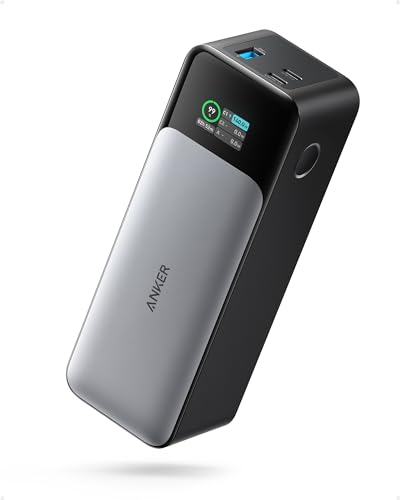
The Anker 737 Power Bank reviewed here is the current-US A1289 PowerCore 24K documented by Anker's US page and V01 quick-start and user manuals.[1][4][5]
It is a plausible fit for a buyer who values up to 140W from one USB-C port, three physical output ports, and an on-device status display more than low weight.[1][4][5]
Its main tradeoffs are a current-US listed weight of 630 g, a 140W ceiling shared across active ports, and the need for the charger, cable, and receiving device to negotiate the required USB-C profile.[1][4][5]
This is not a firsthand test: One Big Review did not buy, handle, charge, discharge, meter, open, or travel with a unit.
No independent efficiency, delivered-energy, sustained-power, recharge-time, or temperature result is admitted because the reviewed test sources did not establish an exact hardware-revision match to this A1289/V01 identity.[24][25]
Confidence is high on the core A1289 identity and published electrical profiles, but only medium on package contents and low-to-medium on the unresolved Gen 1/Gen 2 hardware boundary.[1][3][10]
Identity lock: what this review covers
The in-scope product is the black Anker 737 Power Bank (PowerCore 24K), manufacturer model A1289, under the current US listing.[1]
The documentary lock is Quick Start Guide 51005003422 V01, User Manual 51005003435 V01, and the current US A1289 page.[1][4][5]
A newer Anker guide says the product name will change to Anker Power Bank (24K, 140W), without identifying a new model number.[6]
Anker Malaysia uses the label Anker 737 Power Bank Gen 2, while the current US page does not use a generation suffix.[1][10]
No first-party source reviewed establishes a serial number, production date, or document boundary separating distinct A1289 Gen 1 and Gen 2 hardware.[1][5][10]
For that reason, this article does not put Gen 1 or Gen 2 in the verdict or specification table and does not combine revision-specific measurements.
Explicit exclusions
This review excludes Anker 737 wall chargers, including GaNPrime charger products, because 737 by itself does not identify A1289.[1][10]
It excludes the older B1290 Anker 737 Power Bank (PowerCore 26K for Laptop), which is a different capacity and electrical design.[11]
It excludes the A110A Anker Prime Power Bank (26K, 300W), the A110B Anker Prime Power Bank (20K, 220W), and the A1340 Anker Prime Power Bank (27K, 250W) from A1289 product evidence.[13][14][15]
It also excludes unmatched regional bundles, unmatched colors, package variants not tied to an exact SKU or listing, and unidentified hardware variants.
Those products can appear only as clearly labeled comparison or boundary references; none donates measurements, port behavior, accessories, app features, or safety claims to A1289.
Who should consider it
Consider A1289 if you need one portable bank whose published profiles include up to 28V at 5A from either USB-C output and you already have a compatible high-power device and cable.[1][4]
It is also a reasonable paper-spec fit when a display showing battery and power information matters more than pocketability.[5]
The three-port layout can serve mixed USB-C and USB-A gear, but the total remains 140W rather than 140W per USB-C port when both are active.[3][6]
Who should skip it
Skip it if roughly 630 g and a 6.13 × 2.15 × 1.95-inch body are too much for your normal bag.[1]
Skip it if you expect every laptop, phone, charger, or cable to receive or deliver 140W automatically; negotiated profiles and hardware limits control the actual result.[4][5]
Skip it if you need independently verified delivered energy, sustained output, recharge time, thermal behavior, cycle life, or pass-through behavior for this exact hardware revision, because those questions remain open.
Skip it if you need a wall charger in the box, because no wall charger is established in the exact US package evidence reviewed.[3][8][9]
Method and evidence limits
This review reopened Anker pages and manuals, US regulator guidance, the EPA disposal page, the public UL Product iQ record, and the comparison-model pages on 2026-09-20.
Manufacturer material is used for identity, specifications, intended operation, and package claims.[1]
FAA and TSA sources are used for cabin travel rules, and EPA is used for disposal guidance.[18][20][22]
The EU/GB Declaration of Conformity also identifies the product as A1289, but this review uses it only as identity/date evidence rather than US battery-safety proof.[7]
No customer-review prose, current price, rating, rank, sales count, or popularity claim is used.
TechRadar reports metered results for a unit it calls Gen 1 and distinguishes a later Gen 2, but it does not give the exact serial/date/document boundary needed to match that unit to this review's A1289/V01 lock.[24]
ChargerLAB's retrieved public page did not expose a sufficient exact model/revision identity for admitting its measurements.[25]
Accordingly, this review makes no One Big Review testing claim and publishes no independent metered performance number.
Capacity: three different concepts
Anker publishes a 24,000mAh cell capacity and describes six 4,000mAh cells.[1][4][6]
A first-party Taiwan A1289 page prints a rated energy of 21.6Vdc/86.4Wh.[12]
The 24,000mAh cell-capacity number and 86.4Wh rated-energy number describe the internal battery from different electrical bases; neither is a measured promise of energy delivered over USB.
Delivered USB energy is lower after voltage conversion and operating losses, but no exact-revision independent delivered-energy result is admitted here.[6][24]
Do not compare this bank's 24,000mAh cell rating directly with a device battery's charging result without voltage and conversion context.
Ports, profiles, and sharing
USB-C1 is the only input/output port; USB-C2 and USB-A are output-only in the reviewed documents.[2][6]
USB-C1 input supports 5V/3A, 9V/3A, 15V/3A, 20V/5A, and 28V/5A, with a published maximum of 140W.[1][4][6]
Both USB-C outputs list 5V/3A, 9V/3A, 15V/3A, 20V/5A, and 28V/5A, up to 140W on one port.[1][4][6]
USB-A lists 5V/3A, 9V/2A, and 12V/1.5A, up to 18W.[1][4][6]
The bank's total output is 140W, so two USB-C devices do not each receive 140W simultaneously.[1][3][6]
Anker's newer guide shows C1+C2 sharing 140W, C1+A or C2+A as 100W plus 18W, and all three ports as C1+C2 sharing 122W plus 18W on USB-A.[6]
Anker support describes PIQ 3.0 as PD+QC+PPS, but the captured first-party material does not publish a PPS APDO range, so this article does not invent one.[3]
Charger, cable, and device requirements
The 140W headline is a ceiling under matched conditions, not a constant output or a universal device promise.
The source or receiving device, selected port, and cable must all negotiate the applicable USB-C profile.[4][5]
The V01 manual's specific 28V/5A example is a 2021 16-inch MacBook Pro connected with a USB-C-to-MagSafe 3 cable.[5]
That example does not prove the same result for every MacBook, laptop, phone, console, camera, drone battery, or cable.
A 60W or 100W cable, or a charger/device without the required profile, cannot be assumed to support 140W input or output.[4][5]
USB-C2 and USB-A do not recharge the bank in the newer guide; recharging is through USB-C1.[6]
Size, weight, display, and portability
The current US page lists 6.13 × 2.15 × 1.95 inches (155.7 × 54.6 × 49.5 mm) and 22.22 oz (630 g).[1]
Two other Anker records disagree slightly: one lists 155.8 × 54.5 × 48.8 mm and 607 g, while another lists 155.8 × 54.6 × 49.65 mm and 632 g.[2][3]
This review uses the current US storefront values for the buyer-facing specification while preserving the discrepancy rather than presenting it as a measured production tolerance.
The V01 manual says the screen reports battery temperature, battery health, total input, battery cycles, total output, and screen-use count.[5]
Those are displayed device estimates or counters, not independent laboratory measurements.
Heat, damage, storage, and disposal
Lithium-ion batteries can overheat and enter thermal runaway, including after damage, overheating, water exposure, overcharging, improper packing, or a manufacturing defect.[18][19]
If a lithium-ion battery becomes damaged, EPA says to contact the battery or device manufacturer for specific handling information.[22]
During a flight, FAA says passengers should notify the flight crew immediately if a lithium battery or device is overheating, expanding, smoking, or burning.[18]
Do not puncture, crush, disassemble, burn, or improvise a repair for a damaged pack.[5][22]
The A1289 V01 manual says to store it in a cool, dry place, avoid hot or humid storage, operate between 0°C and 35°C (32°F to 95°F), avoid excessive heat and force, and charge and discharge it once every three months during long non-use.[5]
The manual warns that a power supply or charger not recommended or sold by the manufacturer may create fire or injury risk, but that warning does not prove every third-party charger is unsafe.[5]
EPA says lithium-ion batteries and devices containing them should not go in household trash or municipal recycling bins; use a separate battery/electronics recycler or household hazardous-waste collection point and protect terminals.[22]
Damaged or recalled batteries may need special handling, so confirm acceptance before taking or shipping one to a collection site.[18][22]
No sentence here means the product is safe, fireproof, unable to overheat, or risk-free.
Cabin travel in the United States
As of 2026-09-20, FAA treats power banks as spare lithium batteries that must stay in carry-on baggage, be protected from damage and short circuit, and be removed from a bag checked at the gate or planeside.[18][19]
FAA's ordinary passenger limit is 100Wh per lithium-ion battery, so a particular unit physically labeled 86.4Wh is below that numerical threshold.[12][18][19]
That comparison is not carriage authorization: check that the physical label is present and legible and that the unit is not damaged or recalled.[18][19]
TSA's power-bank page says carry-on Yes and checked bags No, while reserving the final checkpoint decision to the TSA officer.[20]
Airlines and other countries may impose stricter quantity or watt-hour rules, and decisions may vary by carrier, country, route, aircraft/operator, terminal, checkpoint, label condition, and crew or officer discretion.[18][19][20]
Check the operating carrier and every applicable jurisdiction before travel.
This article does not describe A1289 as TSA-approved, airline-approved, flight-approved, or universally permitted.
Recall and certification boundaries
Anker's recall hub, reviewed on 2026-09-20, listed recalled models including A1647, A1652, A1681, A1689, A1257, and A1263 but did not list A1289.[16]
That dated observation is limited to the exact Anker recall-hub content reviewed; it is not proof that no recall exists globally, permanently, for every serial number, or in the future, and it is not evidence that A1289 is safe.[16]
Related Anker recalls name other models and cannot be transferred to A1289 without an exact model or serial match.[16]
The public UL Product iQ page for file E505576 is labeled UL Certified under Power Banks and lists model A1289 for Anker Innovations Limited.[23]
The public record reviewed does not expose the governing standard edition, certification date, or serial/production scope, so this article does not claim UL 2056 certified.[23]
The reviewed package materials do not contain an A1289-specific UN 38.3 test summary; this package-bounded observation is not a claim that no such document exists publicly or privately.
Request documentary evidence from Anker if an A1289-specific UN 38.3 test summary is required.
Package contents and destination state
Package contents are channel- and SKU-sensitive.
Anker's Costco storefront item A1289011 and the Anker Store Amazon listing for ASIN B09VPHVT2Z identify the bank, a guide, a 140W USB-C-to-USB-C cable, and a travel pouch.[8][9]
A separate Anker support article instead lists a 0.6 m USB-A-to-USB-C cable, and another first-party presentation omits some accessory details.[3]
Inspect the exact listing and physical package before purchase; no wall charger is established as included.[3][8][9]
As an Amazon Associate I earn from qualifying purchases.
No affiliate destination or tracking tag is authorized for this draft, and B09VPHVT2Z is retained only as a neutral identity candidate that must be rechecked before any link is approved.[9][26]
Exact-model alternatives
A110B, the Anker Prime Power Bank (20K, 220W), is a lower-capacity alternative with 220W total output, up to 140W from one USB-C port, up to 100W recharging, and app control according to Anker.[13]
A110A, the Anker Prime Power Bank (26K, 300W), lists 26,250mAh, 300W total output, up to 140W from one USB-C port, dual-port input, and app control.[14]
A1340, the Anker Prime Power Bank (27K, 250W), lists 27,650mAh, 250W total output, a separate profile set, and an app/Bluetooth feature set.[15]
These are different products, not evidence about A1289, and this review does not call any one a successor without a first-party source defining that relationship.[13][14][15]
B1290 is included only as an older 737 family boundary, not as a current performance comparator.[11]
Verdict
A1289 makes the clearest case for buyers who need a published 140W single-port profile and accept a heavy, charger-and-cable-dependent system with unresolved revision and package details.[1][4][5]
Its display, two USB-C outputs, and USB-A port improve flexibility on paper, but simultaneous use remains bounded by the 140W total.[3][5][6]
The absence of exact-revision independent measurements means this verdict is based on documented capability and limitations, not proven efficiency, thermals, sustained power, or recharge speed.
Treat the Gen 1/Gen 2 boundary, exact box contents, delivered energy, UL scope, UN 38.3 summary, and current destination identity as open questions.
Publication remains unauthorized, and every travel, recall, package, and destination statement requires another fresh check before a live page or purchase recommendation.
Sources
- https://www.anker.com/products/a1289 : source, accessed 2026-09-20
- https://service.anker.com/product-description/a085g000004xGWmAAM/anker-737-power-bank-powercore-24k : source, accessed 2026-09-20
- https://service.anker.com/article-description/Introduction-to-the-Anker-737-Power-Bank-24K-A1289 : source, accessed 2026-09-20
- https://salesforce-knowledge-download.s3.us-west-2.amazonaws.com/000009094/en_US/000009094.pdf : source, accessed 2026-09-20
- https://salesforce-knowledge-download.s3.us-west-2.amazonaws.com/000009093/en_US/000009093.pdf : source, accessed 2026-09-20
- https://salesforce-knowledge-download.s3.us-west-2.amazonaws.com/000017324/en_US/000017324.pdf : source, accessed 2026-09-20
- https://salesforce-knowledge-download.s3.us-west-2.amazonaws.com/000011143/en_US/000011143.pdf : source, accessed 2026-09-20
- https://costco.anker.com/products/anker-737-power-bank-powercore-24k-24-000mah-3-port-portable-charger-with-140w-output : source, accessed 2026-09-20
- https://www.amazon.com/Anker-PowerCore-Portable-Charger-Compatible/dp/B09VPHVT2Z : source, accessed 2026-09-20
- https://www.anker.com/my/ganprime : source, accessed 2026-09-20
- https://anker.com/uk/products/b1290 : source, accessed 2026-09-20
- https://www.anker.tw/ANKER/moreinfo_177693.htm : source, accessed 2026-09-20
- https://www.anker.com/products/a110b-anker-prime-20k-220w-power-bank : source, accessed 2026-09-20
- https://www.anker.com/products/a110a-anker-prime-26k-300w-power-bank : source, accessed 2026-09-20
- https://www.anker.com/products/a1340-250w-power-bank : source, accessed 2026-09-20
- https://www.anker.com/product-recalls : source, accessed 2026-09-20
- https://www.faa.gov/hazmat/packsafe/lithium-batteries : source, accessed 2026-09-20
- https://www.faa.gov/hazmat/packsafe/airline-passengers-and-batteries : source, accessed 2026-09-20
- https://www.tsa.gov/travel/security-screening/whatcanibring/items/power-banks : source, accessed 2026-09-20
- https://www.epa.gov/recycle/used-lithium-ion-batteries : source, accessed 2026-09-20
- https://productiq.ulprospector.com/en/profile/755883/bbsz.e505576?term=BBSZ&page=1 : source, accessed 2026-09-20
- https://www.techradar.com/phones/phone-accessories/anker-737-power-bank-review : source, accessed 2026-09-20
- https://www.chargerlab.com/charging-compatibility-test-of-anker-140w-pd3-1-power-bank-737-power-bank : source, accessed 2026-09-20
- https://www.ecfr.gov/current/title-16/chapter-I/subchapter-B/part-255 : source, accessed 2026-09-20